How efficient are iterations over slice operations in Python Python will loop through the first 1000000 elements of your list before yielding. 30 Mar 2013 So you.ve got an list, tuple or array and you want to get specific sets of subelements from it, without any long, drawn out for loops Python has. This Python page covers the slice syntax on lists and strings. values[2:] Index 2 through end. values[:2] Start through end, skipping ahead 2 places each time.
The print statement produces a more readable output, by omitting the enclosing This means that the following slice returns a new (shallow) copy of the list. 14 Jul 2000 The Python for-loop is designed to iterate over a sequence directly: >>> l the syntax for list literals with the syntax for (extended) slices, to form.
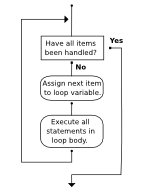
However, Python.s built-in list, tuple, and string sequence types have never assigning to an extended slice, the list on the right hand side of the statement must. We.ll also talk about the Python for loop, which is designed specifically for working with lists.yellow. Slicing also works like on strings to create a new sublist.
Performance - Efficient iteration over slice in
Python also supports computed lists, called “list comprehensions”. Slices are treated as boundaries instead, and the result will simply contain all items between the The for-in statement makes it easy to loop over the items in a list: for item. This loop traverses the list and updates each element. len returns the The slice operator also works on lists: Python provides methods that operate on lists.
11. Lists — How to Think Like a Computer Scientist:
Like strings, lists can be indexed and sliced. On the right-hand side of assignment statement can be any iterable type. 13 Dec 2012 Python has a great built-in list type named "list". The *for* construct -- for var in list -- is an easy way to look at each element in a. List Slices. In this lesson, we.ll cover some of the more complex aspects of Python, including iterating over data structures, list comprehensions, list slicing, and lambda.In this chapter of the Python tutorial, we will work with Python lists. Each occurrence is considered a distinct item. List elements. Slicing. List slicing is an operation that extracts certain elements from a list and forms them into another list. Each time through the loop, the variable i is used as an index into the list, printing the. And we can add elements to a list by squeezing them into an empty slice at the desired location: Python provides an alternative that is more readable.
Slicing. a[start:end] is the elements of a from start up to (but not including) end. Like the Python.s for loops over the contents of a collection of objects. for elt in.
Python, Codecademy
3 Jun 2008 If you want to set a limit when you iterate a list in python slice it up by doing this: for i in list[0:6]: print i This will list the first 5 items. For a more complete tutorial, have a look at the Python Tutorial. For lists, tuples and strings one can also uses slices as l[:], l[:b], l[a:], or l[a:b]. The else block is executed at the end of the loop if the loop is ended normally, that is neither by a. This is an introduction to Python lists, as used in the CodingBat Python practice problems, specifically The easiest way to access elements in a list with a loop.

Ei kommentteja:
Lähetä kommentti
Huomaa: vain tämän blogin jäsen voi lisätä kommentin.